
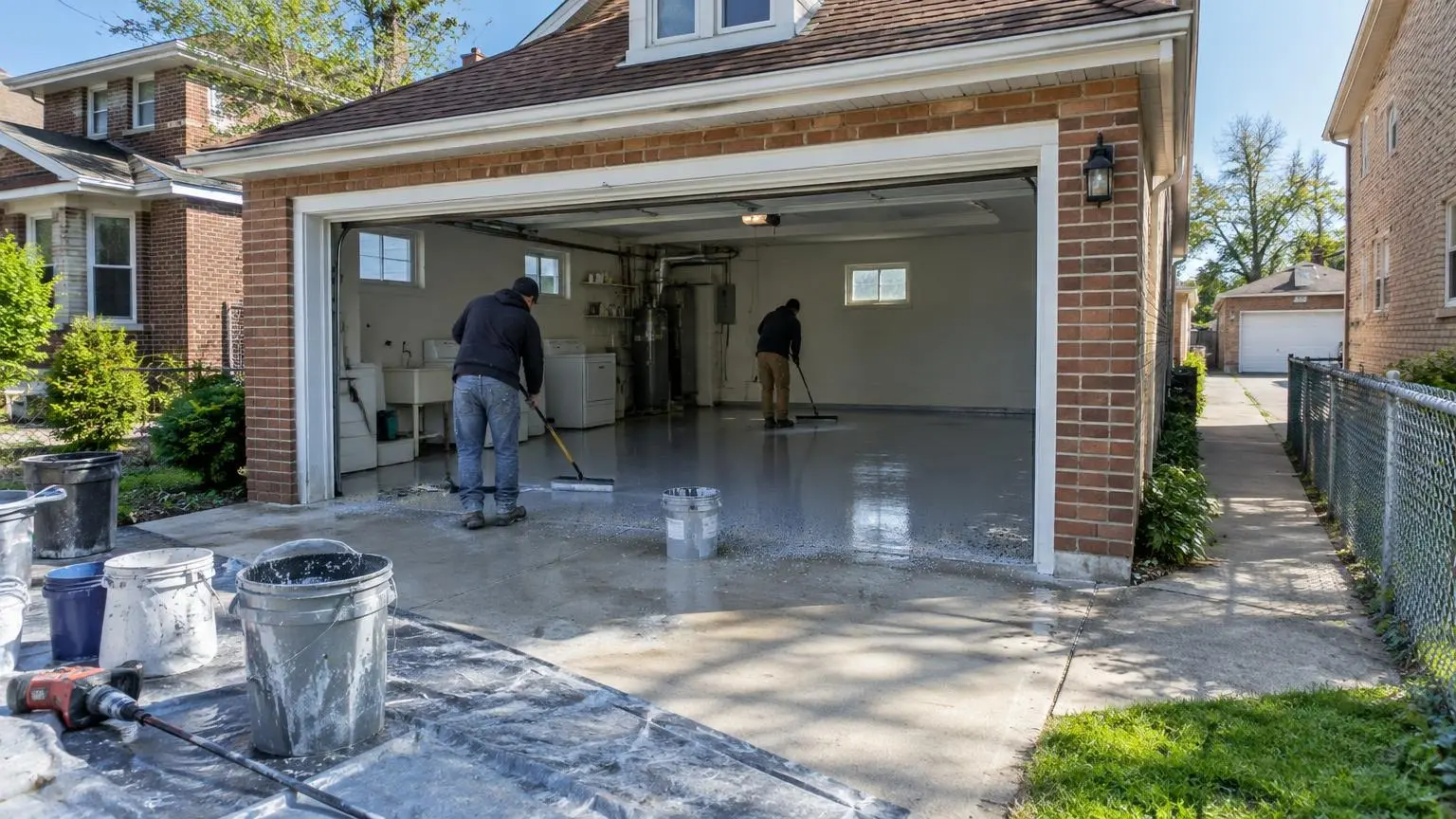
Alley garages, bungalow basements and city work floors
Epoxy Flooring in Chicago, IL
Coatings chosen for slush, salt and humid summers, laid on concrete that has often been poured for generations.
- Free estimate at your property, including a moisture reading on the slab
- A written quote that lists every coat and prep step
- Surface prep explained before we grind a single square foot
Floors Built for a City With Four Hard Seasons
Epoxy flooring in Chicago has to survive two opposite seasons. In winter, tires drag gray slush off salted streets and park it on the slab for months. In summer, the air turns heavy and damp, and that moisture finds its way into garages and basements. We plan every floor around both, starting with the concrete you already have and how you use the space.
Old slabs are the rule here
Census estimates summarized by Point2Homes show 38.8% of Chicago housing was built in 1939 or earlier, and another 7.7% in the 1940s. Wikipedia notes that brick bungalows from the early 1900s through World War II fill large parts of the city away from the lake. A slab that old may carry decades of oil, old paint, patched cracks and sealers nobody remembers applying. Grinding is not optional on that kind of concrete. We open the surface, fill what needs filling and show you on the quote how much prep the floor takes.
Winter: salt, slush and freeze-thaw
Wikipedia lists average snowfall at 38.4 inches at O'Hare and 38.8 inches at Midway, with measurable snow possible into early April. Melting salt brine sits under parked cars and soaks into bare concrete, where it can flake the top layer over time. A flake floor with full chip coverage and a polyaspartic or urethane topcoat seals that surface, and the flakes hide the dried salt rings between washdowns. A slight texture keeps wet boots from sliding.
Summer: humid air on a cool slab
Average relative humidity at O'Hare is 69.6% for the year, and the average July dew point is 61.7 F, according to Wikipedia. When muggy air meets a basement or garage slab that stays cool, the floor can sweat. That matters twice: a damp slab can stop a coating from bonding, and a cured glossy floor can feel slick on a sticky day. We take moisture readings before we quote, and we time application to the conditions in the space.
Two-flats, three-flats and shared garages
About 13% of Chicago housing units sit in two-unit buildings and 14.4% in buildings with three or four units, per the same ACS summary. Many of those lots share a detached garage off the alley, or a basement with laundry and storage for more than one household. If you own a building, we can coat a shared basement in stages so tenants keep access, and we can talk through a simple gray flake that is easy to keep clean between turnovers.
Work floors across the city
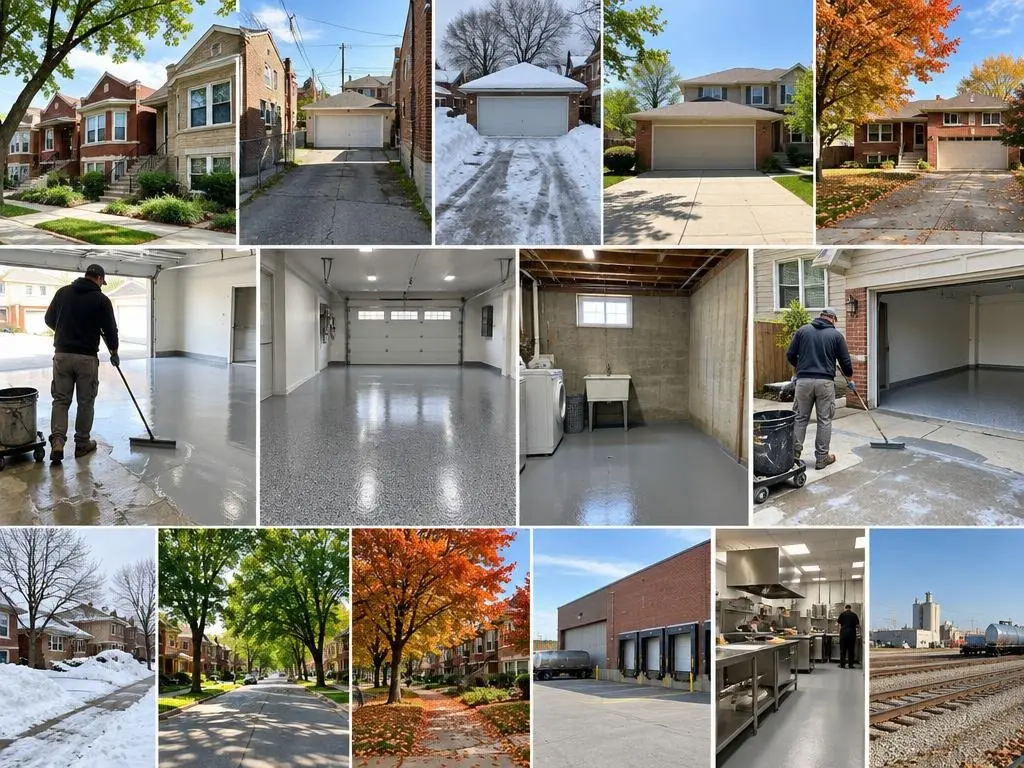
Chicago is a food-processing and rail town. Wikipedia names Conagra, Kraft Heinz, Mondelez and Quaker Oats among the food companies headquartered here, and calls the region the largest railroad hub in North America. Commissary kitchens, loading docks and small shops need floors that handle washdowns, pallet jacks and spills. For those we look at thicker coatings, slip texture and coved edges where walls meet the floor.
Chicago Conditions That Shape a Floor
- Heavy snow seasons. Average snowfall is 38.4 inches at O'Hare and 38.8 inches at Midway, with snow possible into early April.
- Humid summers. Average relative humidity at O'Hare is 69.6%, and the average July dew point is 61.7 F.
- Prewar housing. About 38.8% of housing units were built in 1939 or earlier (ACS 2019-2023, via Point2Homes).
- Multi-unit buildings. Two-unit buildings hold 13% of housing units and three- or four-unit buildings hold 14.4%.
- Food and rail economy. Conagra, Kraft Heinz, Mondelez and Quaker Oats are headquartered here, in North America's largest rail hub.
Chicago Questions
Can you coat a detached alley garage in Chicago during winter?
Usually not in the coldest weeks, unless the garage can be heated and held warm while the coating cures. Most coatings require both the slab and the air to sit above a minimum temperature. We will tell you the earliest window that makes sense for your garage.
My bungalow basement floor has old paint on it. Does that need to come off?
Yes. A coating can only hold as well as the surface beneath it, and old paint lets go. We grind it off, test the bare concrete for moisture and then decide on a primer.
Will road salt ruin an epoxy garage floor?
Salt brine is hard on bare concrete. A sealed floor finished with a chemical-resistant topcoat lasts far longer. Rinsing the floor now and then during winter keeps it looking clean.
Do you work on two-flat and three-flat basements with tenants living there?
Yes. We can split the work into sections so laundry and storage stay reachable, and we give you a written schedule you can share with tenants.
Free Estimates in Chicago, IL
Book a free on-site estimate for your Chicago garage, basement or work floor.
Epoxy Flooring Near Chicago
- Epoxy Flooring in Evanston, IL
- Epoxy Flooring in Skokie, IL
- Epoxy Flooring in Oak Park, IL
- Epoxy Flooring in Berwyn, IL
- Epoxy Flooring in Cicero, IL
- Epoxy Flooring in Oak Lawn, IL
- Epoxy Flooring in Orland Park, IL
- Epoxy Flooring in Tinley Park, IL
- Epoxy Flooring in Naperville, IL
- Epoxy Flooring in Downers Grove, IL
- Epoxy Flooring in Elmhurst, IL
- Epoxy Flooring in Hinsdale, IL
- Epoxy Flooring in La Grange, IL
- Epoxy Flooring in Western Springs, IL
- Epoxy Flooring in Lombard, IL
- Epoxy Flooring in Wheaton, IL
- Epoxy Flooring in Bolingbrook, IL
- Epoxy Flooring in Joliet, IL
- Epoxy Flooring in Palos Heights, IL
- Epoxy Flooring in Evergreen Park, IL
- Epoxy Flooring in Wilmette, IL
- Epoxy Flooring in Winnetka, IL
- Epoxy Flooring in Lincolnwood, IL