
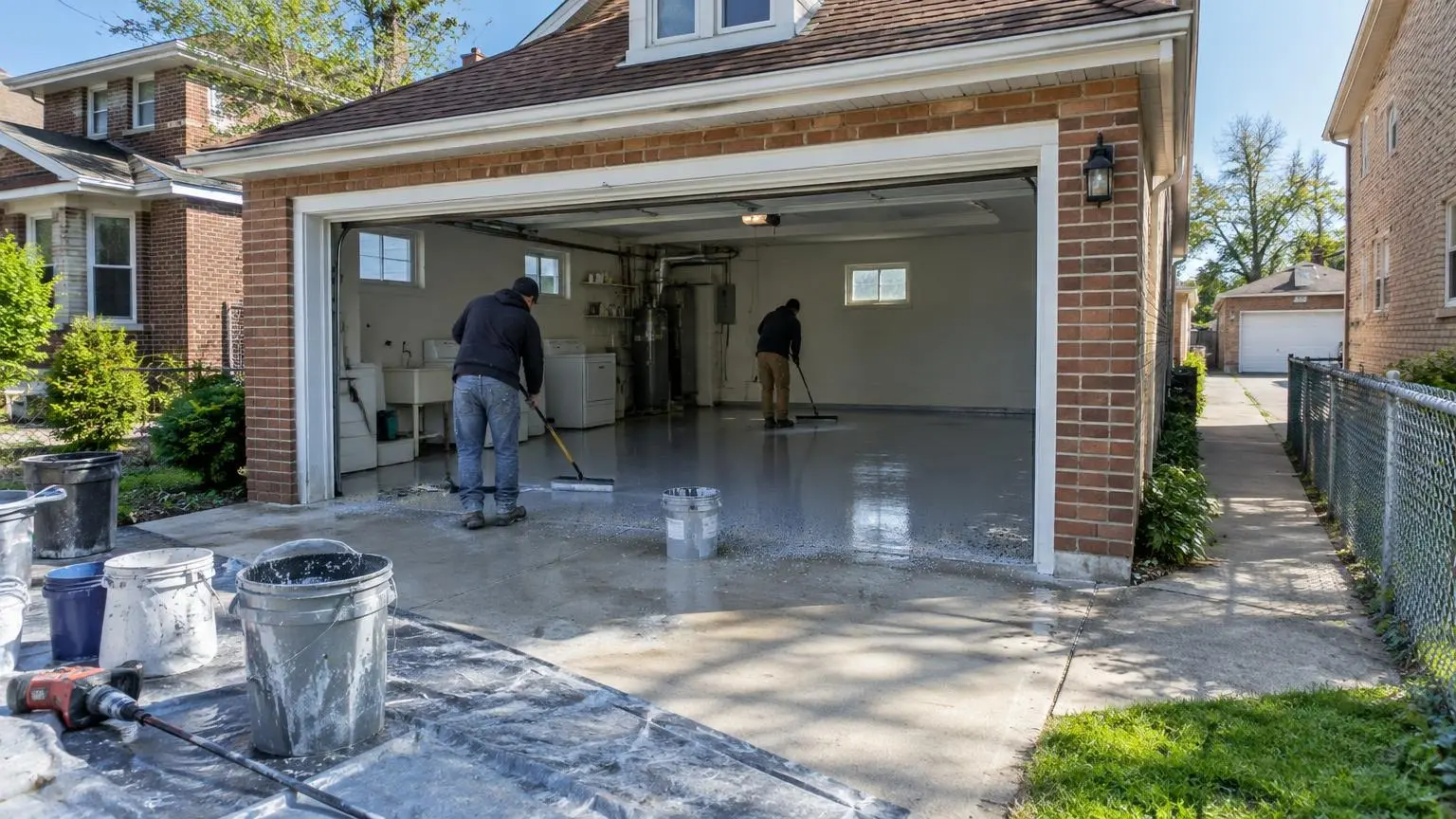
Attached, detached and alley garages
Garage Floor Coatings in Chicago, IL
A sealed, textured floor that keeps salt brine on top of the concrete instead of inside it.
- Free estimate at your property, including a moisture reading on the slab
- A written quote that lists every coat and prep step
- Surface prep explained before we grind a single square foot
Why a Chicago Garage Floor Needs a Coating
Garage floor coatings in Chicago are mostly about winter. From the first snow until spring, your car hauls in slush and salt brine, parks it on the slab and leaves it there to freeze and thaw. Bare concrete soaks that brine up. Over a few seasons the surface near the door starts to pit, flake and scale. A garage floor coating seals the concrete so the brine stays on top and a squeegee can clear it out the door. It also brightens the space, makes it easier to sweep and stops oil from staining the slab.
Epoxy garage floor, polyaspartic, or both
Most of the floors we install are a hybrid: an epoxy base coat that builds thickness and bonds to the ground concrete, vinyl chips broadcast into it, and a polyaspartic or urethane topcoat over everything. That topcoat matters. HomeGuide gives polyaspartic an excellent UV resistance rating, while plain epoxy gets poor to fair, and you notice the difference as yellowing wherever an open door lets the afternoon sun in. Polyaspartic also cures faster, so you are parking sooner. A straight garage floor epoxy system still makes sense in some garages, especially a shaded, heated one, and we will explain the trade-off on your quote.
Salt, freeze-thaw and the first four feet
Wikipedia puts Chicago's average snowfall at about 38 inches a year at both O'Hare and Midway. The damage is rarely spread evenly. It is worst just inside the door and in the two strips under the tires. Before we coat, we look closely at that zone. Scaled or spalled spots get ground out and filled with a repair mortar or epoxy patch so the new surface is flat and solid. If the floor slopes back toward the house or has a low spot that holds water, we flag it, because no coating will keep brine from pooling where the slab dips.
Alley garages versus attached garages
Detached garages on the alley are common on older city lots, and many are unheated. A coating needs the air and slab to stay warm enough to cure, so in an unheated garage we plan the work for a mild stretch of weather instead of the middle of January. Attached garages in the suburbs are often heated, wider and newer, and the usual issues are control-joint cracks and salt wear near the door. Both get the same moisture test and the same grinding.
Prep is most of the job
A lot of older garage slabs have been painted, sealed or stained more than once. A coating bonded to old paint is only as strong as that paint. We diamond grind every garage to remove sealers, paint and the weak top layer, then vacuum the dust and fill cracks, pits and broken control joints. Oil spots are degreased, and if the stain is deep we grind until we reach clean concrete. That is what lets the base coat soak in and lock on.
Living with the floor in winter
A coated floor makes winter cleanup easier, but it does not make salt disappear. Rinsing the floor every few weeks during the season and pushing meltwater out the door keeps dried salt from building up and dulling the finish. A rubber-bottom mat by the house door catches what your boots carry. We go over all of this before we leave, along with the walk-on and park-on times for your system.
Who this is for
Homeowners who park inside all winter, people who use the garage as a workshop or gym, and owners of two-flats and three-flats who want a shared garage that is easier to keep clean all fit here. If you are not sure the slab is worth coating, the estimate visit will tell you. We test, look and give you a straight answer.
More than a parking spot
Plenty of Chicago-area garages double as a workshop, a home gym, a place to store a motorcycle or a spot to work on a project car. Each use changes the floor we recommend. A workshop needs a topcoat that shrugs off dropped tools, solvents and grinding sparks. A gym needs a surface that cleans easily and handles rubber mats and dropped weights, sometimes with a thicker build under the lifting area. A motorcycle or project car means jack stands, lifts and fluids, so we suggest pads under stands and a chemical-resistant topcoat. Let us know what goes on in the garage, and the quote will be built around it.
Coating versus sealing or painting
Some homeowners ask whether a clear concrete sealer or a can of garage floor paint would do the same job. Sealers soak in and help bare concrete resist water, but they leave no wear layer, and they need to be reapplied. Floor paint is thin and tends to lift under hot tires, especially when the slab was not ground. A true resin coating builds a hard film on top of the concrete that you can see and feel. HomeGuide puts the lifespan of thin water-based products at 3 to 5 years and solid epoxy at 10 to 20 years, which is the difference prep and film thickness make.
What a Garage Coating Includes
Each garage floor coating job covers prep, repairs and the full coating system.
Diamond grinding
Strips paint, sealer and weak top concrete so the base coat locks onto solid material.
Salt damage repair
Scaled and spalled spots at the threshold and in the tire paths are ground out and filled flush.
Crack and joint filling
Cracks and broken control joints are filled before the base coat goes down.
Epoxy or polyaspartic base
A base coat that builds thickness and soaks into the open concrete.
Chip broadcast
Optional vinyl chips for texture and to hide dried salt and dirt between cleanings.
Chemical-resistant topcoat
A polyaspartic or urethane clear coat that stands up to brine, oil and hot tires.
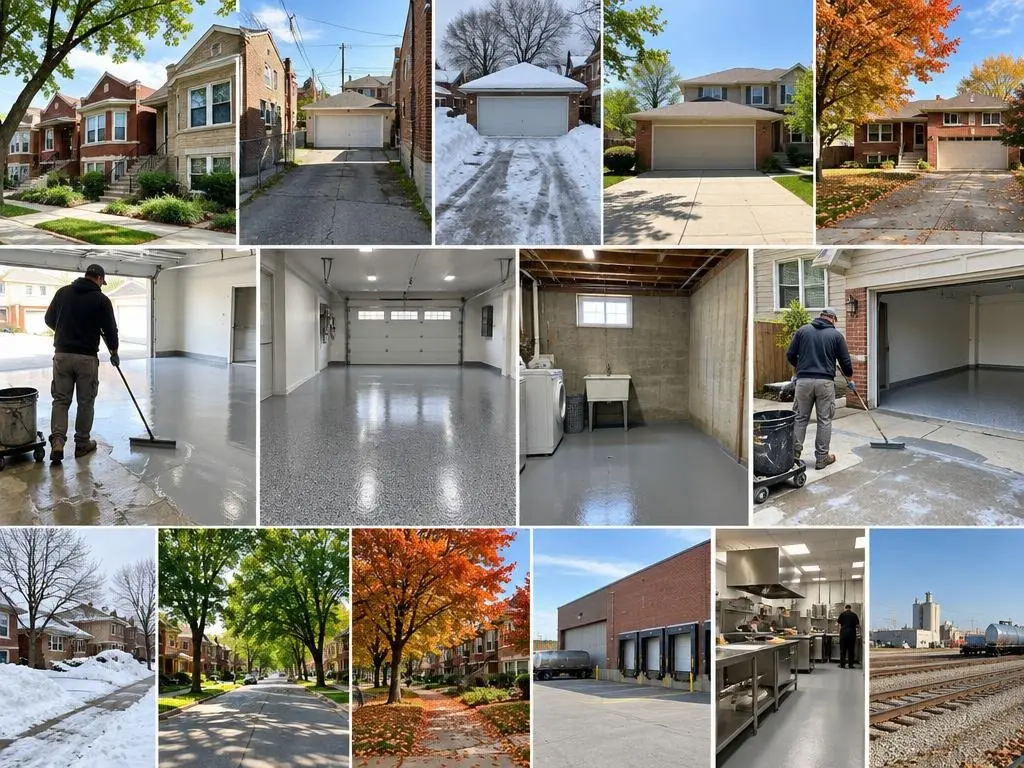
Garage Coating Price Ranges
| Garage or item | National range | Source |
|---|---|---|
| Installed epoxy, per square foot | $4 to $10 | HomeGuide |
| One-car garage, epoxy | $1,200 to $3,900 | HomeGuide |
| Two-car garage, epoxy | $1,600 to $5,800 | HomeGuide |
| Three-car garage, epoxy | $2,300 to $8,600 | HomeGuide |
| Polyurea coating, per square foot | $5 to $10 | HomeGuide |
| Polyaspartic coating, per square foot | $5 to $12 | HomeGuide |
| Patching cracks and chips | $25 to $250 | This Old House |
These are national ranges, not Chicago quotes. Salt damage, old paint and the finish you choose all change the number, and what you pay is the written estimate we prepare once we have seen the slab.
How a Garage Floor Gets Done
1. Look and test
We take measurements, run a moisture test on the slab and inspect the door area for salt damage.
2. Grind and repair
The floor is diamond ground, and cracks, pits and scaled spots are filled.
3. Base and chips
The base coat is rolled out, with chips broadcast into it if your system calls for them.
4. Topcoat
A clear, chemical-resistant topcoat seals the floor.
5. Cure and hand off
We tell you when to walk on it, when to park and how to care for it in winter.
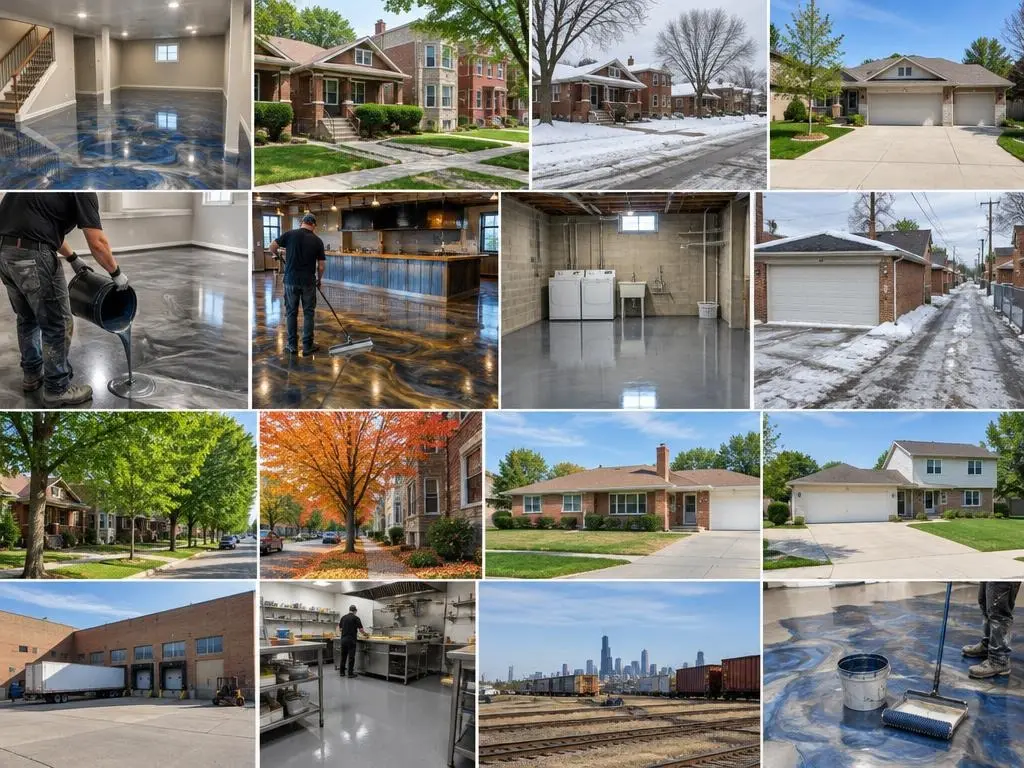
Why Choose Us for Garage Floor Coatings
We fix the door zone first
Salt-scaled concrete near the door is repaired before coating, not hidden under it.
Cold-weather planning
Unheated garages are scheduled for weather the coating can cure in.
Clear choices on the quote
Epoxy, hybrid and full polyaspartic options are written out with cure times.
Garage Floor Coatings Questions
What lifespan should I expect from a garage floor coating in Chicago?
HomeGuide puts solid epoxy at 10 to 20 years and polyaspartic at 10 to 20+ years, while thin water-based products last 3 to 5 years. In Chicago, how well the slab was prepped and how often salt is rinsed off matter as much as the product.
Will road salt damage an epoxy garage floor?
Salt is hard on bare concrete, but a well-bonded coating sealed under a topcoat made to resist chemicals holds up against it. Rinse the floor through the winter so dried salt does not pile up and dull the finish.
Can I coat my garage floor in winter?
In a heated garage, often yes. For an unheated alley garage, we usually hold off until milder weather, since the coating cannot cure unless the slab and the air stay warm.
Is a DIY kit good enough for a garage floor?
HomeGuide lists DIY kits at about $200 to $700. Most are thinner water-based products, and without diamond grinding they often lift under hot tires. On a salted Chicago floor, a professionally ground and coated slab lasts far longer.
When can the car go back in?
HomeGuide advises keeping cars off epoxy for about 2 to 7 days. Polyaspartic can usually take vehicles in 24 to 48 hours. Your quote lists the exact times for the system we install.
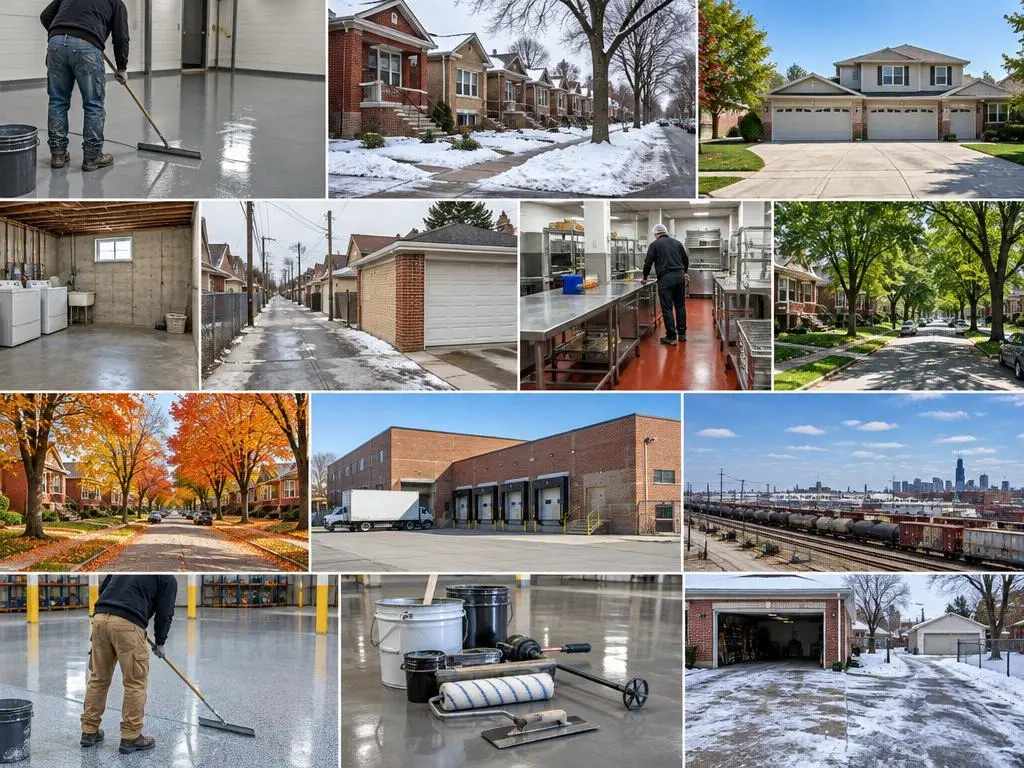
Garage Floor Coatings Service Areas
- Epoxy Flooring in Chicago, IL
- Epoxy Flooring in Evanston, IL
- Epoxy Flooring in Skokie, IL
- Epoxy Flooring in Oak Park, IL
- Epoxy Flooring in Berwyn, IL
- Epoxy Flooring in Cicero, IL
- Epoxy Flooring in Oak Lawn, IL
- Epoxy Flooring in Orland Park, IL
- Epoxy Flooring in Tinley Park, IL
- Epoxy Flooring in Naperville, IL
- Epoxy Flooring in Downers Grove, IL
- Epoxy Flooring in Elmhurst, IL
- Epoxy Flooring in Hinsdale, IL
- Epoxy Flooring in La Grange, IL
- Epoxy Flooring in Western Springs, IL
- Epoxy Flooring in Lombard, IL
- Epoxy Flooring in Wheaton, IL
- Epoxy Flooring in Bolingbrook, IL
- Epoxy Flooring in Joliet, IL
- Epoxy Flooring in Palos Heights, IL
- Epoxy Flooring in Evergreen Park, IL
- Epoxy Flooring in Wilmette, IL
- Epoxy Flooring in Winnetka, IL
- Epoxy Flooring in Lincolnwood, IL
Get a Garage Floor Coatings Estimate
Book a free garage visit anywhere from the city to the outer suburbs.