
Garage, basement and shop floors built for salt and slush
Epoxy Flooring in Chicago, IL
Coatings picked for Chicago winters and humid summers, laid on concrete we grind and test first.
- Free estimate at your property, including a moisture reading on the slab
- A written quote that lists every coat and prep step
- Surface prep explained before we grind a single square foot
Floors That Handle Road Salt, Damp Summers and Old Slabs
Epoxy flooring in Chicago, IL has two jobs most floors never face at once: it has to shed months of salty slush in winter and stay bonded through a humid summer on concrete that is often decades old. Chicago Epoxy Floor Pros installs epoxy floor coating, polyaspartic, vinyl chip and metallic systems on garages, basements, shops and commercial floors across the city and its suburbs. Every job starts with a moisture reading and a close look at the slab, because the right system depends on the concrete you have and how you use the room.
Winter is the real test for a Chicago floor
Wikipedia gives average yearly snowfall of 38.4 inches at O'Hare and 38.8 inches at Midway, and measurable snow can show up into early April. All of that comes home on your tires. Salt brine drips off the car, pools under it and soaks into bare concrete, where repeated freezing and thawing can flake off the top layer. That is the pitting and scaling you see near so many garage doors.
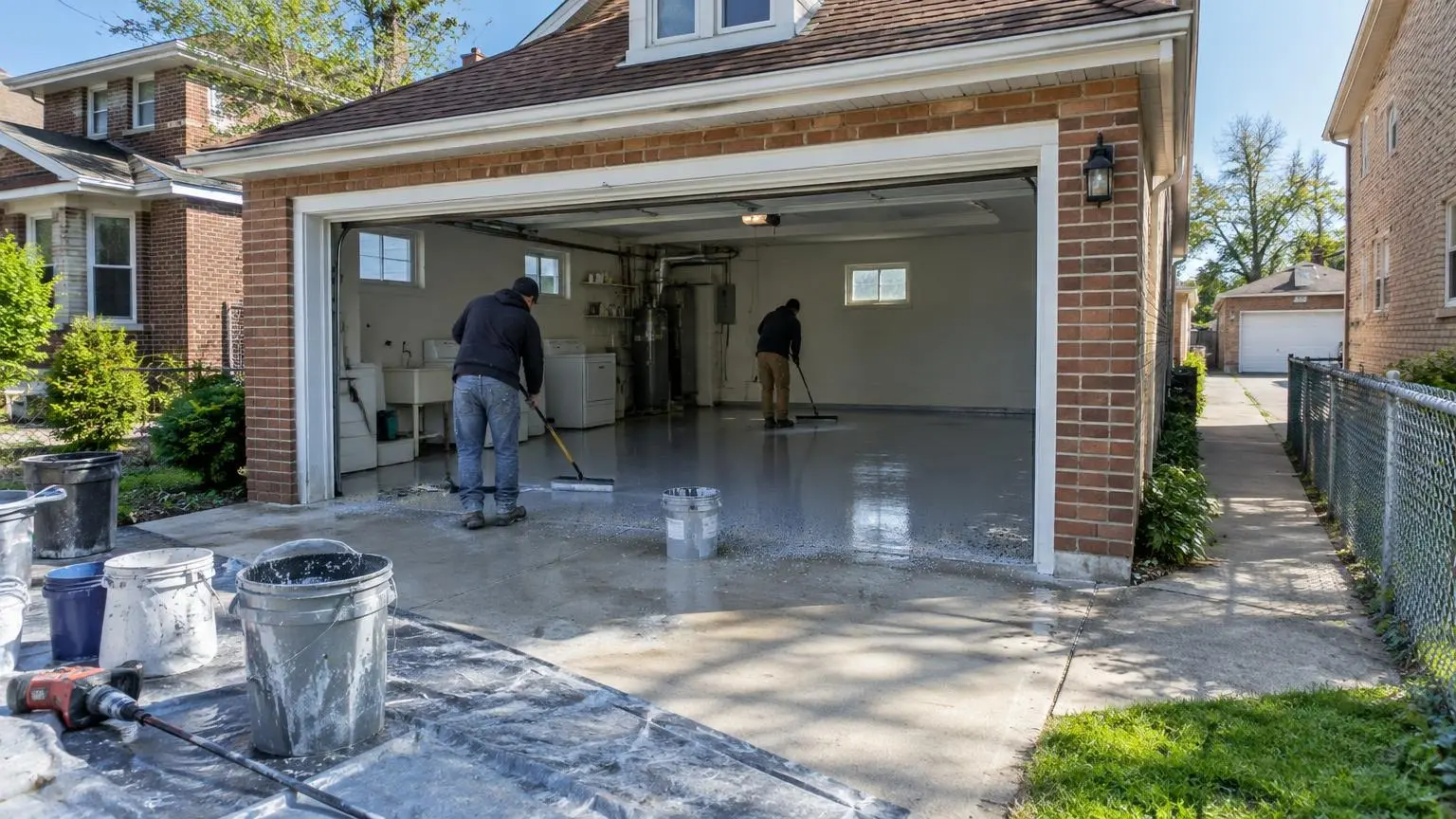
A sealed resin floor holds brine on top, so a squeegee and a hose can push it out the door. For most garages we pair a full vinyl chip broadcast with a polyaspartic or urethane topcoat. The chips hide the dried salt rings between washdowns, and a fine grit in the topcoat keeps wet boots from sliding. Drainage gets a look as well. A floor that tilts back toward the house or dips under the car will hold brine whatever coating is on it, and we flag that on the estimate.
Summer humidity and cool slabs
Wikipedia lists average relative humidity at O'Hare at 69.6% and an average July dew point of 61.7 F. Basement floors and shaded garage slabs stay cool through July, so damp air can condense on them. That causes two different problems. On install day, a slab sitting near the dew point can keep a coating from bonding. After the floor cures, a glossy surface can feel slick on a sticky afternoon.
For the first, we take readings of air and slab temperature plus the dew point before a single kit is opened, and we move the date if conditions are off. For the second, the answer is texture: chips, grit or both.
Old concrete needs real prep
Census figures summarized by Point2Homes show that about 38.8% of Chicago housing units were built in 1939 or earlier, and Wikipedia notes that brick bungalows from the early 1900s through World War II cover large parts of the city away from the lake. Slabs that old tend to carry oil stains, two or three layers of floor paint, patch jobs and sealers nobody remembers putting down. A coating will only hold as well as the surface under it, so we diamond grind every floor down to sound concrete, fill cracks and pits, and tell you on the quote how much prep your floor needs. When a garage coating peels within a year or two, skipped prep is the usual culprit.
Two-flats, alley garages and shared basements
Two-unit buildings hold about 13% of Chicago housing units and three- and four-unit buildings about 14.4%, according to the same ACS summary. Many of those lots have a detached garage on the alley and a basement that several households use for laundry and storage. For building owners, we can coat a basement in sections so tenants keep a path to the washer, and we can recommend a mid-gray chip blend that hides scuffs between turnovers. For detached garages that are not heated, we plan the install for a stretch of weather the coating can cure in, rather than forcing it in the cold.
Working floors in a food and rail city
Chicago is home to the headquarters of food companies such as Conagra, Kraft Heinz, Mondelez and Quaker Oats, per Wikipedia, and the region is the largest railroad hub in North America. Around that economy sit thousands of smaller floors: commissary kitchens, bakeries, auto shops, small warehouses and loading areas. Those floors need thicker coatings, slip texture where things get wet, chemical resistance and sometimes a cove base where the floor meets the wall. Our commercial epoxy flooring page covers how we schedule that work around your hours.
What epoxy flooring cost looks like
Installed epoxy averages $4 to $10 per square foot nationally according to HomeGuide, which works out to roughly $1,600 to $5,800 in a two-car garage. For polyaspartic, the same source lists about $5 to $12 per square foot. Grinding off old paint, repairing spalled concrete near the door and adding chips or a metallic finish all move the number. We price each floor after we have seen and tested it, and the written estimate we hand you is the price.
Questions for epoxy flooring contractors before you sign
Whoever you hire, ask a few plain questions. Will you test the slab for moisture first? Will the floor be diamond ground, or only acid etched? What is in each coat, and how thick is it? What topcoat goes on a floor that sees road salt? How soon can I walk on it, and how soon can the car come back in? Good epoxy flooring companies and epoxy floor installers answer those questions in writing. We put the answers on the quote so you can compare us with anyone else on equal terms.
Picking a system for the room
Most of our work falls into six systems. A garage that sees daily winter parking usually gets a full chip floor with a polyaspartic topcoat. A heated, shaded garage with no rush can do well with a straight epoxy system. Basements get a moisture test first, then a chip, solid or metallic finish depending on how finished the room is. Bars, studios and finished rec rooms are where metallic floors shine. Kitchens, auto bays and small warehouses get thicker commercial coatings with texture. We explain the choice on your quote, along with what the alternative would cost, so you can decide.
How long the job takes
A typical two-car garage takes one to two working days, depending on how much grinding and repair the slab needs. HomeGuide advises waiting about 2 to 7 days before driving onto epoxy, while polyaspartic can usually carry heavy vehicle traffic after 24 to 48 hours. Basements and commercial spaces vary more with size and phasing. Before work begins, you get the walk-on time, the park-on time and the full schedule on paper, which makes it easier to decide where the cars and laundry will live in the meantime.
Common Questions
What are the drawbacks of an epoxy floor?
Standard epoxy tends to yellow in spots that get sunlight, and HomeGuide notes a full cure can stretch to about a week. It also needs real surface prep; on a damp or poorly ground slab it can peel. We reduce those risks with moisture testing, diamond grinding and a UV-stable topcoat where the floor sees light.
What does an epoxy floor coating cost?
Per HomeGuide, installed epoxy runs $4 to $10 per square foot nationally: about $1,200 to $3,900 for a one-car garage, $1,600 to $5,800 for a two-car and $2,300 to $8,600 for a three-car. Old coatings, crack repair and chip or metallic finishes change the total. We price your floor after an on-site visit.
What is better than epoxy flooring?
It depends on the room. For Chicago garages, polyaspartic, either as the topcoat or as the whole system, often makes more sense, since HomeGuide gives its UV resistance an excellent rating and it can take vehicles in 24 to 48 hours. For a damp basement that fails a moisture test, a breathable sealer may be the better choice than any coating. We will tell you which fits.
Can you install a garage floor coating in a Chicago winter?
In a heated, attached garage, often yes. In an unheated alley garage during the coldest weeks, usually not, because the coating will not cure properly unless both the concrete and the air stay warm. We check the conditions and give you a realistic install window.
Should I put epoxy on my basement floor?
It can work well when the slab clears moisture testing. Basement epoxy makes a floor brighter, easier to clean and sealed against spills. The downside is that moisture pushing up through an older slab can lift a coating, so testing comes before anything else, and high readings mean either a moisture-tolerant primer or a different finish altogether.
When is a freshly coated garage ready for the car?
Per HomeGuide, cars should stay off epoxy for roughly 2 to 7 days, while polyaspartic can usually take heavy vehicle traffic in 24 to 48 hours. Your quote will list the exact walk-on and park-on times for the system we install.
Do you coat floors in two-flats with tenants?
Yes. We can split a shared basement into sections and give you a written schedule to share with tenants, so laundry and storage stay reachable during the work.
Our Epoxy Flooring Services
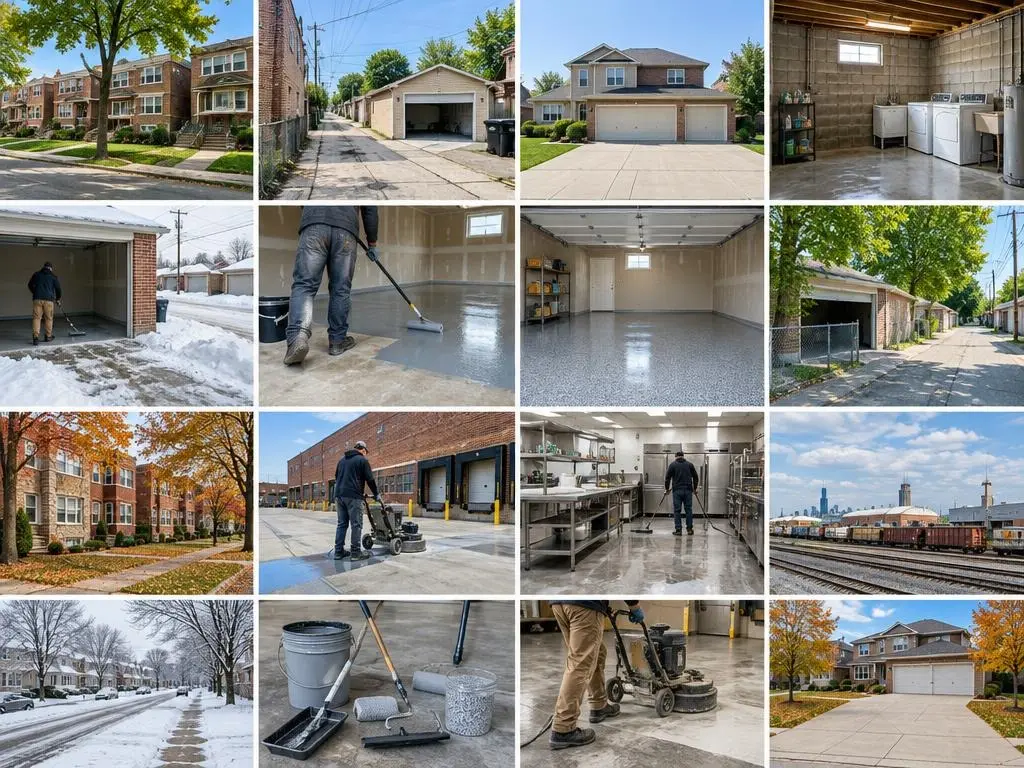
Six coating systems, from salt-resistant garage floors to basement coatings laid after a moisture test.
Garage Floor Coatings
Ground, repaired and sealed garage floors with salt-resistant topcoats for attached and alley garages.
Learn more →Epoxy Chip Floors
Full-broadcast vinyl flake floors that add grip, hide winter grime and come in blends to suit your home.
Learn more →Polyaspartic Coatings
Fast-curing, UV-stable polyaspartic floor coating systems that get your garage back in service sooner.
Learn more →Metallic Epoxy Floors
Poured metallic epoxy floors with swirls and depth for basements, bars, shops and commercial lobbies.
Learn more →Commercial Epoxy Flooring
Tough resin floors and concrete floor coating for kitchens, shops, warehouses and loading areas.
Learn more →Basement Floor Epoxy
Basement floor coatings laid after a moisture test, for laundry rooms, storage areas and finished spaces.
Learn more →Neighborhoods and Suburbs We Cover
We work across Chicago, from bungalow blocks and two-flat streets to newer townhome rows, and in the suburbs around it: Evanston, Skokie, Lincolnwood, Wilmette and Winnetka to the north; Oak Park, Berwyn, Cicero, Elmhurst and Lombard to the west; La Grange, Western Springs, Hinsdale, Downers Grove, Wheaton and Naperville farther out; Oak Lawn, Evergreen Park, Palos Heights, Orland Park and Tinley Park to the southwest; and Bolingbrook and Joliet to the south.
The concrete changes as you move outward. Closer in, we see prewar basements, alley garages and floors with years of paint on them. In the newer suburbs, garages are wider and attached, and the usual problems are control-joint cracks and salt scaling near the door. Each town page explains what we look for there.
- Epoxy Flooring in Chicago, IL
- Epoxy Flooring in Evanston, IL
- Epoxy Flooring in Skokie, IL
- Epoxy Flooring in Oak Park, IL
- Epoxy Flooring in Berwyn, IL
- Epoxy Flooring in Cicero, IL
- Epoxy Flooring in Oak Lawn, IL
- Epoxy Flooring in Orland Park, IL
- Epoxy Flooring in Tinley Park, IL
- Epoxy Flooring in Naperville, IL
- Epoxy Flooring in Downers Grove, IL
- Epoxy Flooring in Elmhurst, IL
- Epoxy Flooring in Hinsdale, IL
- Epoxy Flooring in La Grange, IL
- Epoxy Flooring in Western Springs, IL
- Epoxy Flooring in Lombard, IL
- Epoxy Flooring in Wheaton, IL
- Epoxy Flooring in Bolingbrook, IL
- Epoxy Flooring in Joliet, IL
- Epoxy Flooring in Palos Heights, IL
- Epoxy Flooring in Evergreen Park, IL
- Epoxy Flooring in Wilmette, IL
- Epoxy Flooring in Winnetka, IL
- Epoxy Flooring in Lincolnwood, IL
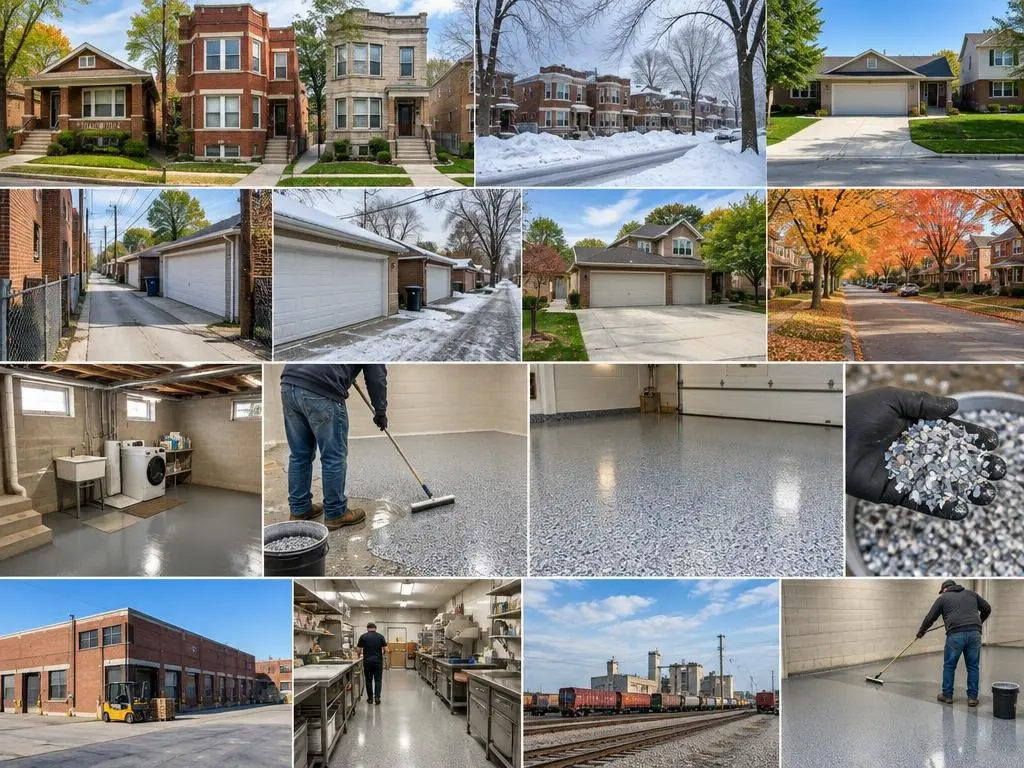
Why Homeowners Call Chicago Epoxy Floor Pros
Moisture tested before we quote
We take a reading on the slab during the estimate, so the system and primer on your quote match the concrete you actually have.
Grinding, not shortcuts
Every floor is diamond ground to open, sound concrete. Old paint, sealer and loose patches come off before any coating goes down.
Topcoats chosen for salt
Garage floors get a chemical-resistant polyaspartic or urethane topcoat, and a grit or chip texture so wet winter boots grip.
Everything in writing
Each quote lists the system, every coat, the prep work, the cure times and the total, and the figure on it is what you pay.
Book a Free Floor Estimate
Our visit covers measuring, a slab moisture check and a quote on paper. Reach us at (773) 900-4863 or through the form.