
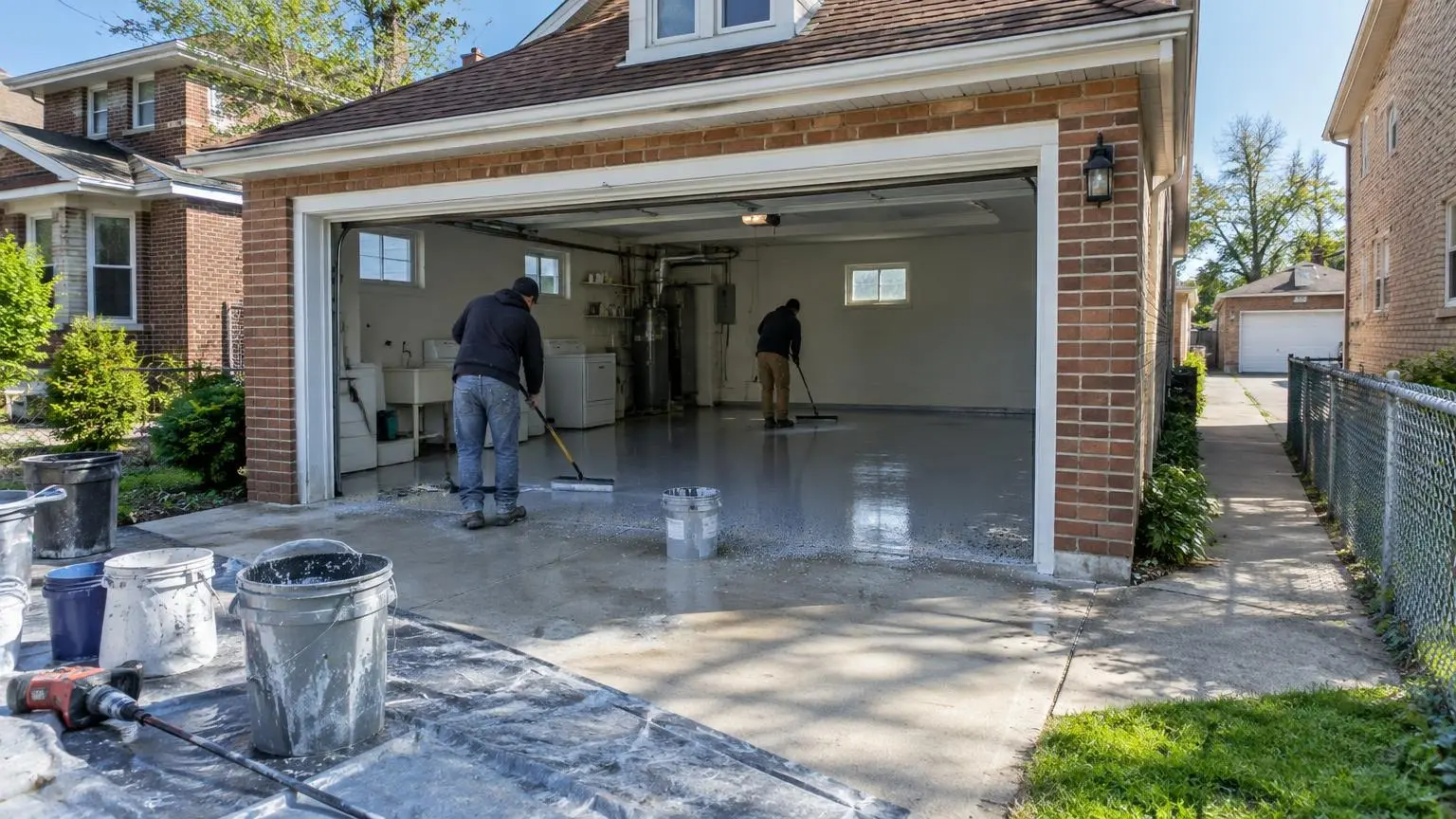
Bungalow, two-flat and suburban basements
Basement Floor Epoxy in Chicago, IL
A cleaner, brighter basement floor, coated only after the slab passes a moisture test.
- Free estimate at your property, including a moisture reading on the slab
- A written quote that lists every coat and prep step
- Surface prep explained before we grind a single square foot
Basement Epoxy: The Pros, the Cons and the Moisture Test
Basement floor epoxy in Chicago starts with a question most installers skip: is the slab dry enough to coat? Basements here are often old. Census figures summarized by Point2Homes show about 38.8% of Chicago homes were built in 1939 or earlier, and many of those basement floors were poured without a vapor barrier. Moisture moves up through that concrete, and a sealed coating sitting on top can trap it. That is why we test before we talk about colors.
The pros of a coated basement floor
A basement floor coating makes a gray, dusty slab bright and easy to clean. It seals the concrete so it stops shedding dust, it resists laundry spills and detergent, and it makes a storage area or workshop feel like part of the house. A chip or metallic finish can turn an unfinished basement into a usable rec room or gym without carpet that can trap damp or tile that can crack.
The cons, stated plainly
Epoxy is not right for every basement. If moisture pushing up through the slab is high, it can lift a coating in bubbles or patches. Coatings do not fix water coming in through cracks or along walls; that needs drainage or foundation work first. Epoxy is also hard underfoot, and a glossy finish can be slippery when damp. We deal with each of these by testing, fixing what we can, adding texture and telling you when a different option, such as a breathable sealer, fits better.
Moisture testing is the first step
During the estimate we test the slab and look for signs of water: efflorescence, white crusty deposits, staining along walls, damp corners and old water lines. Summer is a good time to check. Wikipedia lists the average July dew point at O'Hare at 61.7 F, so humid air can condense on cool basement concrete and make a floor feel wet even when no water is coming in. We separate surface condensation from moisture coming up through the slab, because they need different fixes.
Bungalow and two-flat basements
Many older city basements have been painted more than once, patched around old plumbing and floor drains, and used as laundry rooms for decades. We grind off old paint, fill patches and cracks, and pay close attention to the floor around the drain so water still runs to it. In two-flats and three-flats where several households share the basement, we can coat in sections so the laundry stays reachable.
Suburban basements
Newer suburban basements tend to have better slabs, but they still crack along control joints and can show damp spots in wet springs. Many are being finished as family rooms or gyms. A coated floor works on its own or under area rugs, and it holds up better than carpet if a sump pump ever falls behind.
Choosing a system
For laundry and storage areas, a full chip floor hides dirt and adds grip. For finished rooms, a partial chip or metallic finish looks more polished. When moisture readings are borderline, a moisture-tolerant epoxy primer goes under the system. We write the primer, each coat and the prep into your quote so you know what is going down.
Laundry rooms and floor drains
In many Chicago-area basements, the laundry corner is where the floor takes the most abuse: detergent, bleach, water from an overflowing washer and heavy appliances that get dragged out for repairs. A coated floor in that area makes cleanup quick. Around floor drains, we keep the slope toward the drain and feather the coating into it, so water does not pond around the edge. Slip resistance matters here too, so we usually add texture in the laundry area even when the rest of the basement is smoother.
Basements used as gyms, shops and storage
A basement gym needs a floor that wipes clean and handles rubber mats; a basement workshop needs one that resists solvents and dropped tools; a storage room needs one that stops dust from rising off bare concrete. A coated floor covers all three. If you plan to put down rubber flooring or rugs over part of it, tell us, and we will keep the finish under them simple.
When a coating is not the answer
If the test shows heavy moisture, a sealed epoxy floor is a risk. In that case we may suggest fixing drainage or grading first, using a breathable penetrating sealer instead, or waiting until the moisture source is addressed. We would rather tell you that at the estimate than come back later to a floor that failed.
Getting a basement ready for the crew
Before we start, the floor needs to be cleared of boxes, shelving and anything stored on it. Washers and dryers can often be moved aside for one section at a time. Let us know about floor drains, sump pits, radiator pipes or support columns, since we work around each one. We keep the area ventilated during the install and let you know when the floor is ready for foot traffic and your belongings. In a shared basement, a written schedule for tenants keeps everyone informed.
What a Basement Coating Includes
Every basement floor coating starts with a moisture test and full prep.
Moisture testing
We test the slab and look for signs of water before recommending a system.
Paint and sealer removal
Old floor paint and sealers are ground off to bare concrete.
Crack and drain-area repair
Cracks and patches are filled, keeping slope to the floor drain.
Moisture-tolerant primer
Used on slabs with borderline readings.
Chip, solid or metallic finish
Picked to suit how the room gets used.
Textured topcoat
Grit added for traction on floors that can get damp.
Basement Coating Price Ranges
| What is priced | National range | Source |
|---|---|---|
| Installed epoxy, per square foot | $4 to $10 | HomeGuide |
| Epoxy resurfacing, per square foot | $3 to $7 | HomeGuide |
| Polyaspartic, 300 sq ft | $1,500 to $3,600 | HomeGuide |
| Patching cracks and damaged areas | $25 to $250 | This Old House |
| DIY epoxy kits | $200 to $700 | HomeGuide |
National figures, shown so you have a frame of reference. Old paint, moisture primers and crack repair are what move basement prices most, and the written estimate we leave after testing is the price.
How a Basement Floor Gets Coated
1. Test and inspect
Moisture readings first, plus a look for stains, crust and damp corners.
2. Honest recommendation
If moisture is too high, we say so and suggest other options.
3. Grind and repair
Old paint comes off, and cracks and patches are filled.
4. Prime and coat
Primer, base and finish go down, with texture where you want it.
5. Cure and use
You get the time for foot traffic and for moving shelving back.
Why Choose Us for Basement Floor Epoxy
We test before we quote
Moisture is checked during the estimate, not after the floor fails.
We will tell you no
When a slab holds too much moisture for coating, we tell you plainly.
Shared basements handled
Phased work so tenants keep access to laundry and storage.
Basement Floor Epoxy Questions
What are the pros and cons of an epoxy basement floor?
Pros: a bright, sealed, easy-to-clean floor that stops concrete dust and resists spills. Cons: high slab moisture can lift it, it does not stop water leaks, and a glossy finish can be slick when damp. Testing and texture address most of the cons.
Do you test basement floors for moisture?
Yes, on every basement. We test during the estimate and recommend a moisture-tolerant primer or another finish when readings are high.
Can a basement floor with old paint be coated?
Yes, after we grind the paint off. A new coating will not hold well over old paint, so it all comes off first.
Will epoxy fix a wet basement?
No. A coating does not stop water coming through cracks or walls. That needs drainage or foundation work first, and we will point it out if we spot signs of it.
Is epoxy cold or hard underfoot?
It is a hard surface, like the concrete under it. Many people add area rugs in finished rooms, which is fine on a coated floor.
Basement Floor Epoxy Service Areas
- Epoxy Flooring in Chicago, IL
- Epoxy Flooring in Evanston, IL
- Epoxy Flooring in Skokie, IL
- Epoxy Flooring in Oak Park, IL
- Epoxy Flooring in Berwyn, IL
- Epoxy Flooring in Cicero, IL
- Epoxy Flooring in Oak Lawn, IL
- Epoxy Flooring in Orland Park, IL
- Epoxy Flooring in Tinley Park, IL
- Epoxy Flooring in Naperville, IL
- Epoxy Flooring in Downers Grove, IL
- Epoxy Flooring in Elmhurst, IL
- Epoxy Flooring in Hinsdale, IL
- Epoxy Flooring in La Grange, IL
- Epoxy Flooring in Western Springs, IL
- Epoxy Flooring in Lombard, IL
- Epoxy Flooring in Wheaton, IL
- Epoxy Flooring in Bolingbrook, IL
- Epoxy Flooring in Joliet, IL
- Epoxy Flooring in Palos Heights, IL
- Epoxy Flooring in Evergreen Park, IL
- Epoxy Flooring in Wilmette, IL
- Epoxy Flooring in Winnetka, IL
- Epoxy Flooring in Lincolnwood, IL
Get a Basement Floor Epoxy Estimate
Free moisture testing and estimates for basement floor epoxy in Chicago and nearby suburbs.